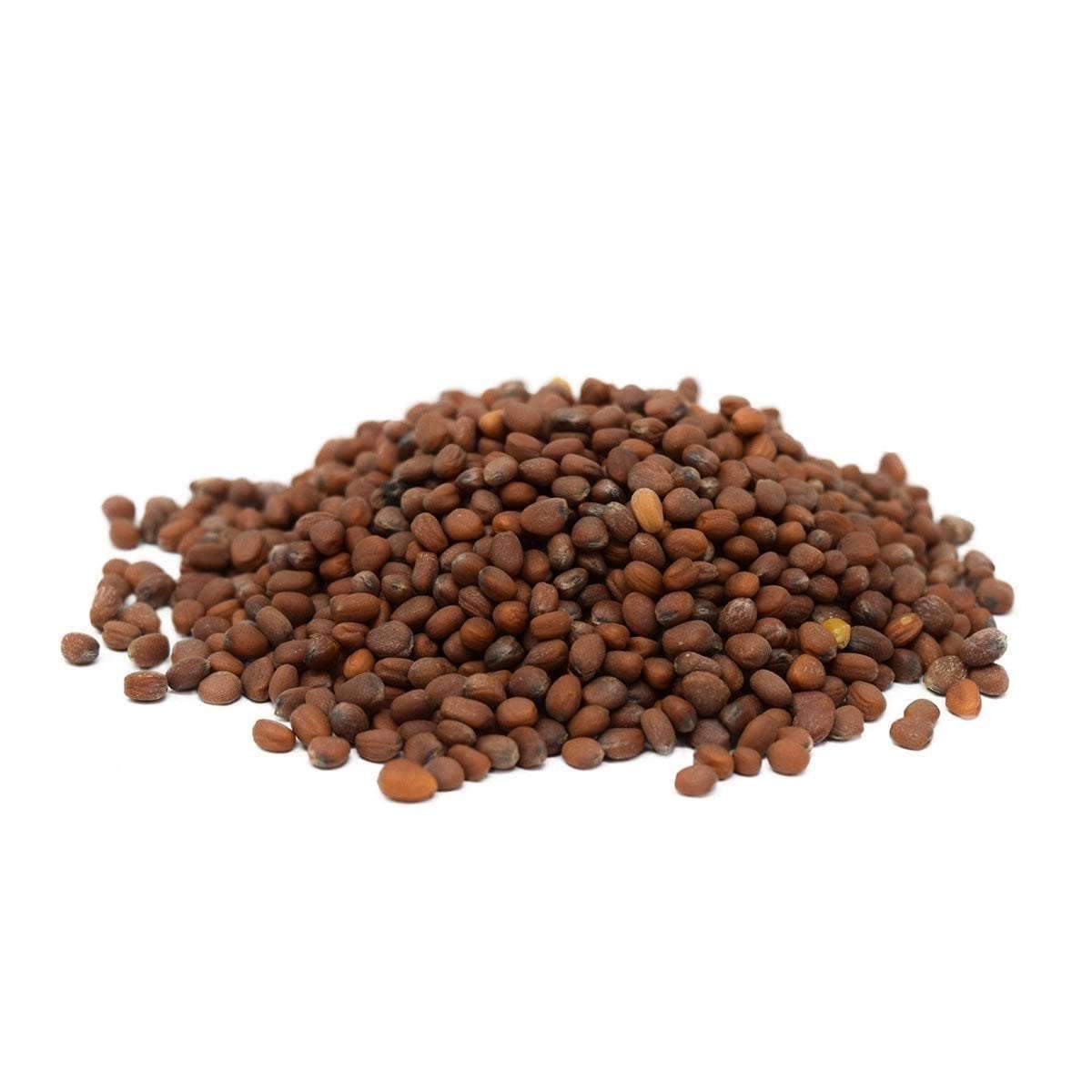
plant radish seeds Daikon Radish Seed
SKU: 48629618765
plant radish seeds

plant radish seeds Daikon Radish Seed

Sale price$20.87 Regular price$23.19
Save 10%

Shipping Estimate
USA
  • USA
  • CAN

Ships within 48 hours · Estimated delivery Jul 8 - Jul 13

Promo Codes Available:

For Your Every Summer RSVP, with Code: SUMMER15

Description

plant radish seeds Daikon Radish SeedDaikon Radish is great for food plots, winter cattle forage and soil improvements. ~~~ Daikon Radish is great for food plots, winter cattle forage and soil improvements. Product Information Application or Use: Pasture, Cattle Forage, Livestock Grazing, Food Plot, Soil Improvement Germination Time: 5 7 days, under optimal conditions Growing Locations: Warm Season, Transition Zone, Cool Season Height: 1 2 feet Sunlight Requirements: 6 8 hours, full sun

Daikon Radish is great for food plots, winter cattle forage and soil improvements. ~~~

Daikon Radish is great for food plots, winter cattle forage and soil improvements.

Product Information

  • Application or Use: Pasture, Cattle Forage, Livestock Grazing, Food Plot, Soil Improvement
  • Germination Time: 5 - 7 days, under optimal conditions
  • Growing Locations: Warm Season, Transition Zone, Cool Season
  • Height: 1 - 2 feet
  • Sunlight Requirements: 6 - 8 hours, full sun for best results
  • Advantages: Handles grazing pressure well - sprouts new growth quickly.
  • When to Plant: Recommended planting time is spring and fall when night time temperatures are consistently below 65 degrees.


Product Details

  • GMO-Free
  • Fast growing, will smother weeds
  • Handles grazing pressure well - sprouts new growth quickly
  • Protein levels in the top and root are better than 20%
  • Radishes aerate and loosen compacted soil, even heavy clay


Product Information

Daikon Radish is great for food plots, winter cattle forage and soil improvements. Daikon Radish tap root looks like carrots growing to lengths of 18 to 24 inches. Deer eat both the green top and the radish itself. Daikon Radish is also used in soil improvements as well as cover crop.  Daikon Radish is very aggressive and will germinate and thrive in most soils types around the world. Great for no till food plots!

One of the biggest benefits behind Daikon Radish is its potential as a source of forage for both deer and cattle. Because the Daikon Radish is so hardy, it can thrive in almost climate and will continue to thrive even as Winter temperatures set in. This makes Daikon Radish a popular form of cattle forage during the Winter months as well. During the Summer, it's just as popular a source of forage because of its aggressive growing tendencies, and how quickly it sprouts new leaves after being consumed. 

Daikon Radish have been a popular as a form of sustenance for residents of Southeast Asia for thousands of years. Thanks to its mild taste, it has found new audiences across the world in more recent years. Daikon Radishes can be stored for weeks, even without their leaves, if they are stored in a cool place. In Japanese cuisine, they are often pickled. 

Obviously the large root leaves behind a significant cavity in the soil, making it an optimal option for breaking up soil, including heavy clays, for those who wish to plant new crop options in years to come. Studies have shown that this taproot leaves more than 6 to 10 inches of effect on soil compaction. The word "Daikon" actually translates to "big root" in Japanese! 

One additional way to use your Daikon Radish is for the traditional Japanese art of Rokusho, patination or coloring of non-ferrous metals. One of the last steps in the process is to actually rub down the treated metal, which has traditionally been done for centuries by using a Daikon radish! Hancock Seed cannot, however, provide all the copper acetate, sodium hydroxide and other chemicals required for the process. Actually, we're just going to recommend you use this amazing root as a cover crop, wildlife forage option, or for your own table!

*Product packaging may appear different than what is pictured. 

**Daikon Radish Seed is GMO-Free** ~~~

Daikon Radish will thrive in any one of the three climate zones, when planted during the late Summer, or early Fall. Seed at a rate of 10 to 15 lbs. per acre, and fertilize at a rate of 300 lbs. per acre with a 19-19-19 fertilizer (equal parts nitrogen, phosphorus and potassium). Cover seed at a depth of half-an-inch.

We recommend rotating Daikon Radish fields at least every 2 to 3 years to prevent the development of fungi.

Shipping Notes
  • Free Standard Shipping on $100+ Orders to the USA.
  • Except Preorder products are shipped in 48 hours.
  • Delivery to the USA:
  1. Standard Shipping : 3-10 business days
  • If time is of the essence, please consider selecting expedited delivery for faster service.
Exchange/Return Notes
  • We offer a 30-day return/exchange service after receiving.
  • Final sale items are not eligible for returns or exchanges.
  • To process your return/exchange, please contact us at [email protected]
  • Please click here for more details>>> Return & Exchange Policy
SKU: 48629618765

Discover Niche Categories That Outsell plant radish seeds

Top-Converting Item to Boost Your Average Order

4.0 ★★★★★
Based on 1938 reviews
Sort
Highest Rating
Newest First
Oldest First
Product Reviews
R
Verified Purchase
Rocco Dormarunno
Chelsea, US
★★★★★ 5
Search for Scapegoats
Format: Hardcover
Jill Lepore's "New York Burning: Liberty, Slavery, and Conspiracy in Eighteenth-Century Manhattan" is a valuable and admirable examination of one of the darkest episodes in New York's history: the so-called slave rebellion of 1741 and the brutal vengeance that was extracted. Professor Lepore's painstaking research confronts the reader with a terrible conclusion: even the most respectable of people in society will consent to the deaths of human beings, based on even the tiniest shreds of evidence. Focusing primarily on the actions of Daniel Horsmanden, the City's Recorder, Lepore provides the reader with a background on the attitudes of New York's whites toward their slaves. She makes clear that Gotham was neither the first nor only city to have witnessed slave uprisings. (It had suffered a similar uprising a couple of decades earlier.) But the events of 1741 were unique for several reasons: --the shifting finger-pointing at various groups; --the inconsistency of Mary Burton's testimony, which essentially was the case against several slaves;and --Horsmanden's bizarre behavior toward Mary Burton. Admittedly, I've only superficially studied this dark time in New York's history, so I was shocked to learn that there were actually several "conspiracies": the Negro Plot, Hughson's Plot, the Spanish Plot, the Roman Plot, etc. Each plot was hatched depending on who confessed to what. Worst of all, the white population of New York--fueled by racism, xenophobia, paranoia, and, not the least of all, bloodlust--went right along with it. And, with the exception of an intriguing anonymous letter from Massachussetts, it seems the rest of the colonies went along with it, too. While Horsmanden is just short of villified in this book, he is not alone in his culpability. Professor Lapore's "New York Burning" will disturb many readers. The accounts of the slaves and the few whites burning, hanging, begging, and praying are graphic and heartbreaking. Still, this in an incredibly important book for anyone interested in the history of our nation and/or the all-too-tragic fragility of race relations in America. For this, Professor Lapore deserves our appreciation
WAS THIS REVIEW HELPFUL?YesReportShare
Reviewed in the United States on June 8, 2006
R
Verified Purchase
Reckless Reader
Belleville, US
★★★★★ 5
Spectacular Albeit Unknown History of Race Relations
Format: Hardcover
This is a great piece of historiography about something few know about at all --- slavery in New York City in the 18th century. How about a slave "rebellion" in New York City, how about more people burned at the stake than in the Salem witchcraft trials, how about dark byways and highways of old New York, barely transformed from its days as New Amsterdam, dark plots in dank places, shrill frightened tyrants overreacting with bloody retribution, burned ruins of an early African American village in Central Park? One cannot make up this stuff, it is too real so it must be history at its best. And written by one of our premier authors of history, a woman who makes our history live in The New Yorker to the acclaim of many, and yet whose best book, this one, is still too little known. If you appreciate Harry Truman's remark that the only new thing under the Sun is the history you haven't read, then this is one to curl up with and marvel at; a great way to spend a rainy day or a dark night.
WAS THIS REVIEW HELPFUL?YesReportShare
Reviewed in the United States on January 22, 2010
M
Verified Purchase
Michael Pointer
Whiting, US
★★★★★ 4
Good, but not great.
Format: Paperback
Kudos to Lepore for delving into an important, little known subject, which she does better than most historians. At times, however, I think she felt the need to put every little piece of information she got into the book. It was way too long. Some good research, but she has done better. Still, worth checking out. I like to think I know American history, but I know nothing about this awful chapter.
WAS THIS REVIEW HELPFUL?YesReportShare
Reviewed in the United States on April 1, 2019
J
Verified Purchase
John Warren
New York, US
★★★★★ 5
DAMN, this is a great book!
Format: Hardcover
All history books should be this detailed, this readable, this humane. Lepore knows how to write about a horrible, nearly forgotten episode in NYC history. Unlike many historians, she steps away from overt politics or raw emotion. She knows that this subject is too serious to be shouted. It is the rare history book that is packed with facts as well as knowledge. I felt like Lepore was taking my hand and leading me through the smelly streets of lower Manhattan in 1741, like I could almost see the faces of...what were they, anyway? The victims of a horrible hoax? The demented planners of a plot to burn the city? Or something in between, where thieves can also be the keepers of ancient rites from a distant homeland, where the world is turned upside down? I could go on and on, but just buy the book!
WAS THIS REVIEW HELPFUL?YesReportShare
Reviewed in the United States on May 20, 2008
K
Verified Purchase
Kim Burdick
Alexandria, US
★★★★★ 3
New York Burning
Format: Paperback
. This is an important book that explores in depth what is usually only found in textbooks as a one-sentence summation: "In 1741 there was a slave uprising in New York City." Scholars will probably be happier starting with the Appendix and bibliography and then reading the book. The text is disorganized and uneven, and although this is non-fiction, the characters could have been more finely drawn. Peter Zenger's trail keeps popping up in unexpected places, often disconnected from the action the author is working on. Some sections are heavy on primary documents and period writings, others are more poetic. Yes, I do understand the parallels with the Salem Witch Trials. The Salem Witch Trials get more press today because of Arthur Miller's "Crucible." Color and religion of the participants aside, both events are stories of group think and mass hysteria, fear and anger. There is plenty of room here for a first-class film or play to be written. Read this book, learn from it. Expect to complain about it. Kim Burdick Stanton, DE
WAS THIS REVIEW HELPFUL?YesReportShare
Reviewed in the United States on November 7, 2014

recommand products